How can AI models be trained when data cannot be collected and stored in a central location? This is one of the questions being explored by the DREAM and MoE projects within the Advanced Digitalisation programme.
Both projects bring together companies and research organisations to develop the next generation of AI systems for autonomous vehicles and other data-intensive environments. One of the organisations participating in both projects is deep-tech company Scaleout, which develops solutions for decentralised AI.
“We are exploring new ways to train AI where the data is generated, enabling edge systems to learn and adapt locally, reducing dependence on constant connectivity, and delivering resilient AI where and when it matters most,” says Salman Toor, CTO and co-founder of Scaleout.
AI that learns where the data is
Today, AI development often involves collecting data centrally to train models. But in sectors such as automotive, defence and smart manufacturing, this is not always possible. Data may be sensitive, subject to regulatory requirements or simply too extensive to move.
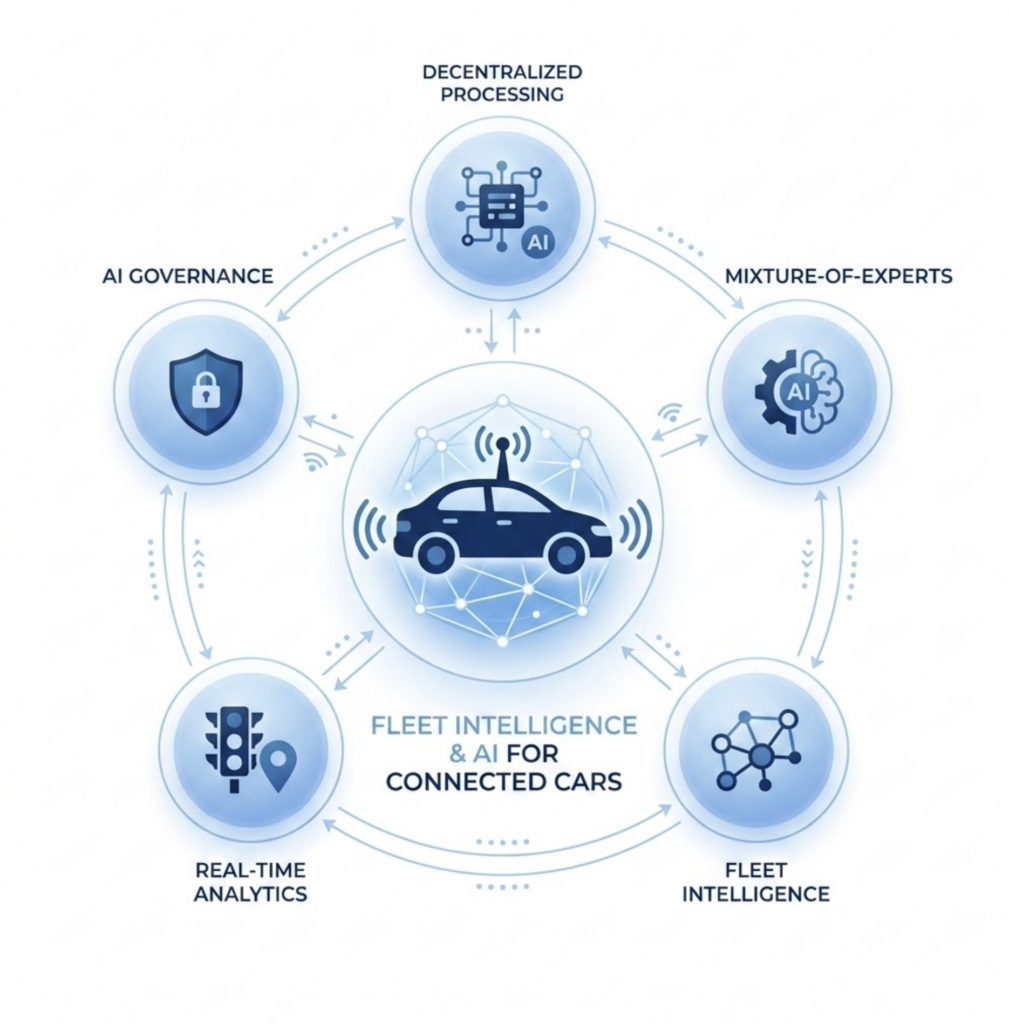
Decentralised AI, powered by federated learning, offers a practical alternative to centralized AI. The technology enables AI models to be trained locally, where the data is generated, while knowledge is shared between systems without the underlying data itself having to be transferred.
“Autonomous vehicles generate enormous amounts of data from cameras, radar and other sensors. At the same time, the requirements for safety and accuracy are extremely high,” says Salman Toor.
More robust AI for different environments
The MoE project, led by Scaleout, is developing AI models that are better able to handle different weather conditions and environments.
A self-driving vehicle needs to perform just as reliably in snow and darkness as it does in sunshine and dense urban traffic. The project uses Mixture of Experts (MoE) models, where different parts of the AI model specialise in different situations, such as weather conditions or information from different sensors. Instead of using the entire model for every situation, the system activates only the experts it needs. This makes the AI more modular, efficient, and robust, while reducing the amount of computation required during operation. A recent blog post, Why AI Misses What Matters in a Storm, highlights these challenges and demonstrates the effectiveness of this approach.
“Our aim is to contribute to more robust and accurate models that work in real-world environments, not just in laboratories,” says Salman Toor.
The project is being carried out together with partners including Sweden’s national centre for applied AI, AI Sweden, and technology company Zenseact .
Focus on resilient AI systems
Scaleout is also participating in DREAM, a project within Advanced Digitalisation led by RISE. The project focuses on how distributed AI systems can become more robust and efficient through improved communication and self-supervised learning.
The project brings together organisations including RISE, Zenseact, AI Sweden and Scaleout to investigate how future vehicle fleets can collaborate and learn from one another, even when network connectivity is limited.
“We see efficient communication as absolutely critical. Systems need to be able to evolve, adapt and share knowledge even when transferring large amounts of data is not possible,” says Salman Toor.
Strengthening Swedish competitiveness
According to Salman Toor, the technology has potential far beyond automotive applications—from smart cities and industry to logistics and defence. Scaleout’s dual-use technology is already being adapted for defence, including its Tactical Computer Vision Network (TCVN), which brings resilient AI to tactical edge environments.
He also highlights the importance of the Advanced Digitalisation programme.
“Turning advanced AI research into real-world solutions requires strong collaboration. The Advanced Digitalisation programme gives us the opportunity to work with the right partners, validate our technology in realistic environments, and turn promising ideas into practical, deployable innovations with applications across both civilian and defence domains.,” he says.
Looking ahead, he envisages a society in which more and more AI systems are trained and deployed close to the source of the data – in vehicles, factories, buildings and critical infrastructures.
“The need for decentralised AI will only continue to grow. That is why it is important that we start developing solutions today that can operate effectively and reliably in demanding, real-world environments.”
Scaleouts’ work has also received international recognition, as well as attention within the security sector. Scaleout wins the 2026 TechSweden Security Award, presented by Minister of Defence, Pål Jonson.

Project Facts
Mixture of Experts models Tailored for Fleet Intelligence (MoE)
Project lead: Scaleout Systems AB
Partners: Scaleout, AI Sweden and Zenseact
Project period: August 2025–August 2027
Funder: Vinnova through the Advanced Digitalisation programme
Goal: To develop scalable, efficient and privacy-preserving AI solutions for vehicle fleets by combining federated learning with Mixture of Experts models.
Budget: Funding from Vinnova: SEK 4,043,633
Purpose: To develop next-generation decentralised AI that enables vehicles to train models and share knowledge without transferring raw data.
DREAM – Distributed, Robust and Efficient AI for Autonomous Vehicles
Project lead: RISE Research Institutes of Sweden AB
Partners: RISE, Zenseact, Scaleout and AI Sweden
Project period: September 2025–August 2027
Funder: Vinnova through the Advanced Digitalisation programme
Goal: To develop safer and more generalisable AI for autonomous vehicles and strengthen Sweden’s competitiveness in the automotive industry.
Budget: Funding from Vinnova: SEK 7,910,500
Purpose: To advance federated learning for autonomous vehicles by improving efficiency, robustness and adaptability in large-scale, real-time environments.