As Swedish industry transitions toward fossil-free production, the demands for power, capacity, and smarter energy use are increasing. In the AIDE project – Advanced Industry, Digitalization, and Electrification – four partners are collaborating to develop solutions that make industry more electricity-flexible and competitive.
The project is led by GKN Aerospace, Trollhättan Energi, University West, and Innovatum Science Park. Magnus Kuschel, Innovation Manager at Innovatum Science Park, is responsible for driving the project forward. With a PhD in Informatics and experience from both Volvo Group and Stanford University, he describes the project as “the starting point for something much bigger.”
The Industry Challenge: Capacity Shortages and Power Peaks
Electrification is advancing rapidly – but the risk of capacity shortages in Swedish power grids is preventing companies from expanding.
Magnus explains:
– In Western Sweden, we already see clear cases of capacity shortages. Companies that want to grow are not always granted new grid connections. This is not just a strategic issue, it is a daily obstacle.
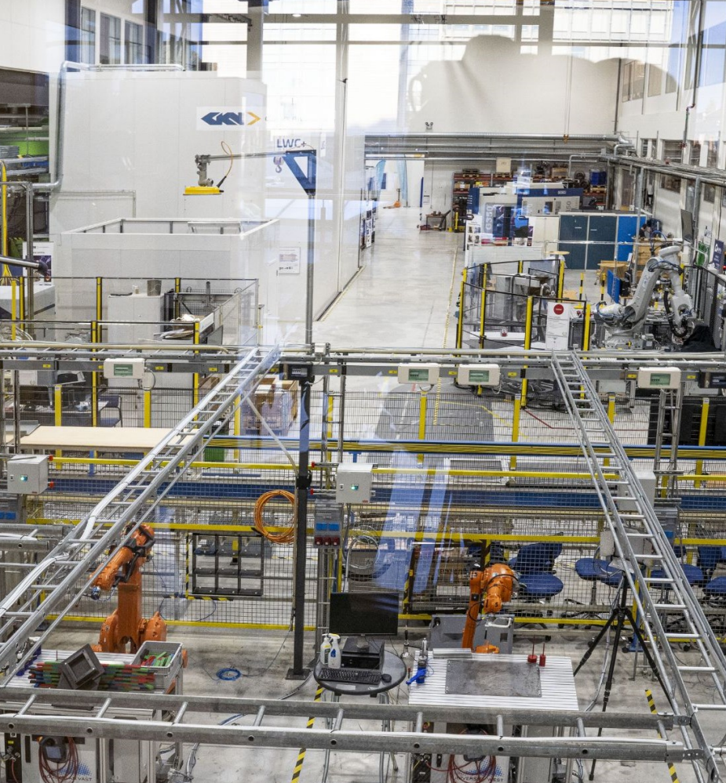
At the same time, factories are filled with advanced machines that are rarely connected or coordinated through production planning. This leads to unnecessary power peaks and underutilized capacity.
– When all machines start at 07:30, we get, put simply, completely unnecessary power peaks. One machine runs at an unnecessarily high load while another is idle – there is potential for flexibility instead of traditional ways of planning production.
AIDE’s Solution: Electricity Flexibility through a New Level of Data Sharing
Within the AIDE project, sensors are installed on machines and furnaces, data is shared, and production planning can account for dynamic power demand. The goal is to orchestrate production – not just within a single factory, but across multiple operations within the same industrial area.
– The project was initiated to help manufacturing companies both identify and manage their power peaks. In one way, we address this machine by machine, and in another, one industrial area at a time. This allows local challenges to meet regional conditions while strengthening competitiveness and contributing to sustainable development.
The work is carried out both on the factory floor and from a broader industrial area perspective, creating two levels of impact:
- Improved internal productivity and flexibility
- Greater system-level benefits in local power grids
– It’s about moving from thinking in silos to thinking in systems-of-systems. Factories represent one system level, the industrial area another, and the city a third. When digitalization enables data exchange, the benefits increase dramatically.
Unique Collaboration Enables Holistic Solutions
AIDE is based on collaboration between industry, energy providers, academia, and innovation environments. This makes it possible to test solutions to complex problems directly where they arise.
– It’s a bottom-up approach. We leverage digitalization where operations actually exist – in the machines, with the operators, and in production.
This interdisciplinary approach means the project delivers not only technology but also new ways of working. University West contributes research, work-integrated learning, and skills development; Trollhättan Energi provides the grid perspective; and GKN contributes industrial needs.
A Scalable Method for All of Sweden
The project has developed a five-step model that makes electricity flexibility practically achievable:
- Mapping potential
- Prioritization based on power impact and cost/revenue
- Installation of sensors and data collection
- Testing, validation, and calibration
- Measurement, control, and real-time optimization
– Of course, many details are involved, and co-development is essential at every step. At the same time, we already have several examples showing improvements well above ten percent, and even greater gains in released capacity. This is both scalable and exportable.
The model makes it easier for other companies to adopt similar approaches and directly strengthens the competitiveness of Swedish industry.
Technology + Teamwork = Implementable Innovation
Magnus also emphasizes that organizational trust is just as important as technology:
– Facts are facts, but without relationships, there is no implementation. Industrial areas have a natural level of trust that allows us, through digitalization, to break down barriers more quickly and create real system benefits.
Looking five to ten years ahead, Magnus believes projects like AIDE will transform how industry plans both production and energy use.
– We haven’t even seen all the possibilities yet. But the potential is enormous – for competitiveness, sustainability, and export. It will require both hard and smart work, but the opportunities are in our hands.
The work within AIDE demonstrates that collaboration and advanced digitalization are key to enabling Sweden to manage electrification, strengthen industry, and reduce climate impact at the same time.
Project facts
Project name: AIDE – Advanced Industry, Digitalization and Electrification
Partners: GKN Aerospace, Trollhättan Energi, University West, and Innovatum Science Park
Budget: SEK 983,009 (government funding)
Funder: Vinnova – Advanced Digitalization – Electrification
(Call: Advanced Digitalization for Industrial Electrification)
Purpose: To create value by linking sensor data from the factory floor to strategic, tactical, and operational decision-making for industrial electrification.