AI development and adoption are advancing rapidly. The focus is no longer solely on large language models, but on a broad and rapidly expanding range of applications across industry, public services and digital infrastructure. As AI becomes integrated into more organisations and demand for computing power grows, data centres face entirely new requirements – particularly in terms of power density, cooling and power supply.
Behind the rapid development of AI lies a physical, energy-intensive infrastructure that risks becoming a limiting factor. These challenges are central to H-DINI – High-Density AI Digital Infrastructure supporting 6G. Funded through Avancerad Digitalisering, the project is expected to deliver technical solutions that enable the sustainable expansion of digital infrastructure, with a focus on energy-intensive AI hardware.
– We are looking at how the sharp increase in computing demand, driven primarily by AI, can be accommodated in data centres in a sustainable and technically feasible way, says Jonas Gustafsson, H-DINI Project Manager and Senior Researcher at RISE.
The project brings together organisations from across the data centre value chain – from materials research and simulation to power distribution, server design, cooling technology and heat recovery. Participants include ABB, APR Technologies AB, Enoc System AB, Ericsson AB, Hitachi, Luleå University of Technology, Perstorp AB, RISE and SHT Smart High-Tech.
– No single organisation can solve these system-level challenges alone. The value lies in having the entire chain represented and being able to focus on integration rather than individual components, says Jonas Gustafsson.
Power densities beyond conventional data centre design
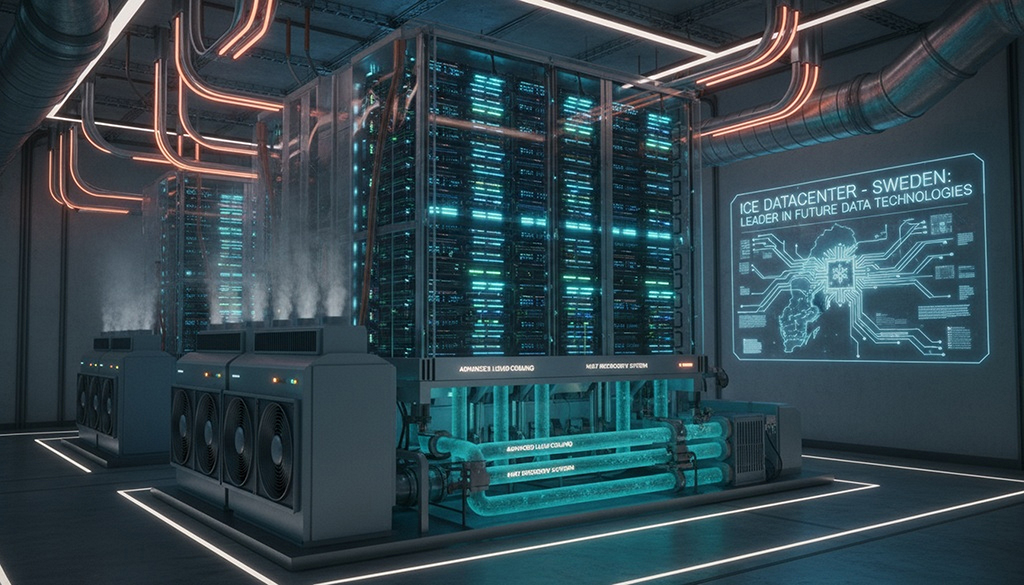
Traditional data centres are designed for power levels of around 5–10 kW per rack and rely primarily on air cooling. For AI training, these levels are far from sufficient. Modern AI chips generate several kilowatts of heat over very small areas, and power levels exceeding 100 kW per rack are already a reality. Looking ahead, levels approaching one megawatt per rack are being discussed.
– The power density of today’s processors is extreme. It is comparable to that of a nuclear reactor, but concentrated in a much smaller area. Air cooling is simply no longer enough, says Jonas Gustafsson.
H-DINI is investigating different forms of liquid cooling and how cooling can be integrated as close to the chips as possible. A key parameter is thermal resistance across the entire system – from the processor, through thermal interface materials, to the coolant.
Lower thermal resistance unlocks new possibilities
Thermal resistance describes resistance to heat transfer. Low thermal resistance is essential for efficiently removing large amounts of heat without component temperatures exceeding critical limits. It also enables more effective heat recovery, allowing heat to be captured and transferred at higher temperatures with minimal losses.
– The lower the thermal resistance, the higher the temperature at which we can recover waste heat. And the higher the temperature, the more valuable that heat becomes, says Jonas Gustafsson.
Instead of releasing heat into the surrounding environment, the project aims to enable its reuse, for example for heating or other industrial applications. Higher operating temperatures also reduce the need for conventional chillers, further lowering energy consumption.
Instead of releasing heat into the surrounding environment, the project aims to enable its reuse, for example for heating or other industrial applications. Higher operating temperatures also reduce the need for conventional chillers, further lowering energy consumption.
New approaches to power distribution for extreme power demands
The challenges extend beyond cooling. As power density increases, power distribution must also evolve. Delivering very high power levels within a small area pushes existing low-voltage solutions to their limits.
– 48 volts is no longer enough. To reduce losses, we need to increase the voltage, and many indications point towards levels of around 800 volts. These are the same voltage levels often used for fast charging electric vehicles, says Jonas Gustafsson.
Higher voltage means lower current, which in turn reduces losses in cabling and allows a greater proportion of the electricity purchased to reach the computing circuits.
Full-scale demonstrators as a shared platform
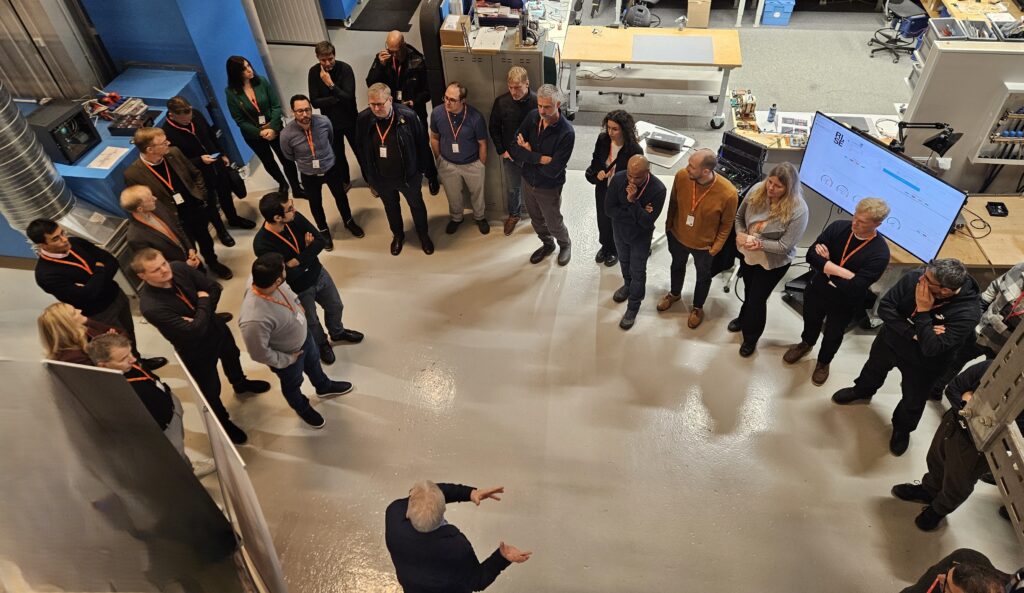
A key ambition of H-DINI is to build physical demonstrators at RISE ICE, the RISE research institute’s testbed for digitalisation and IT infrastructure. These will bring together several of the project’s technical approaches in a shared environment, such as high-power racks with integrated cooling and heat recovery.
– Building something at full scale creates a completely different level of engagement. It makes the technology more tangible and helps the partners collaborate, says Jonas Gustafsson.
The demonstrators are also seen as a way to validate existing technologies that have not yet been used in such extreme environments.
Connecting AI development and 6G
H-DINI highlights the importance of developments in 6G systems, where computing, AI and communications are becoming increasingly interconnected. Running AI functions close to the user requires new types of cloud and edge infrastructure capable of delivering very high performance.
– Backend computing resources and AI are central to value creation, and this type of modern infrastructure is absolutely essential, says Jonas Gustafsson.
Strengthening Swedish competitiveness
Alongside its technical results, the project is generating new collaborations. In the longer term, H-DINI aims to help Swedish organisations establish a strong position in the global market for data centre and AI infrastructure.
– We want the solutions we develop to be deployed in commercial data centres within three to ten years. If we can also help reduce energy losses and increase the temperature of recovered heat, we will have made real progress, Jonas Gustafsson concludes.
The project’s relatively large budget makes it possible to involve multiple organisations across the entire value chain. This breadth is necessary to develop innovative system-level solutions rather than address isolated problems. The scale of the budget is made possible by funding through Avancerad Digitalisering, combined with strong industry engagement and substantial co-funding from participating companies. Together, these commitments create the conditions for developing the sustainable AI infrastructure that will be crucial to Sweden’s future competitiveness.

Project Facts
Project name: H-DINI – High-Density AI Digital Infrastructure supporting 6G
Project lead: Jonas Gustafsson, RISE Research Institutes of Sweden
Partners: RISE Research Institutes of Sweden, ABB AB, Alfa Laval Nordic AB, APR Technologies AB, Chalmers University of Technology AB, Ericsson AB, FläktGroup Sweden AB, Grundfos Holding A/S, Hitachi Energy Sweden AB, Lubricants UK Limited (Castrol), Luleå University of Technology, Perstorp AB and SHT Smart High Tech AB.
Project period: July 2025 – June 2028
Funder: Vinnova through Avancerad Digitalisering – Industrial Needs-driven Innovation (2025 call).
Goal: To strengthen Sweden’s position as a global innovation hub for high-performance, sustainable digital infrastructure and develop technical solutions for energy-efficient and sustainable AI infrastructure.
Total budget: SEK 56,285,840
Purpose: To promote collaboration between industry, research institutes and academia to address the technical challenges arising from the rapid development of AI and turn these challenges into business opportunities and sustainable infrastructure solutions.