In modern industry, almost all components are flawless—the challenge lies in quickly and reliably identifying the ones that are not. When thousands of parts pass through a factory every day, defects become difficult to detect, yet crucial to find in time—especially for smaller manufacturers.
With the project Production-Integrated Visual Inspection Based on Unsupervised Machine Learning, Linné University, Gimic, Gunnebo Industrier, and Willo are tackling exactly this problem. Together, they are developing an AI-based method that can identify anomalies without large datasets, expensive sensors, or long startup times—making advanced quality assurance accessible even to small and medium-sized manufacturers.
Advanced Digitalization has interviewed three key individuals in the project: Welf Löwe, Professor of Computer Science at Linné University; Diana Unander, Project Manager at Linné University; and Sebastian Hönel, Postdoctoral Researcher and Lead Scientist in the project.
– Companies are generally very good at producing correct parts. The problem is finding the needle in the haystack—the few products that do not meet the standard, says Welf Löwe.
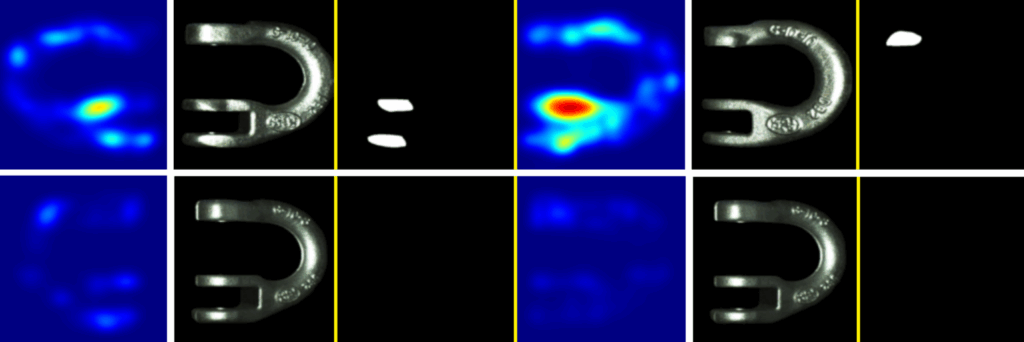
Unlike traditional AI solutions, the technology they have explored and further developed does not require thousands of examples of defects to function. Instead, the data model learns what is correct and flags anything that deviates.
Collaboration Across the Entire Value Chain
One of the project’s greatest strengths is the broad collaboration across the entire value chain, where different types of actors contribute their specific expertise. Academia develops and refines research-based methods, the technology provider Gimic translates these methods into practical system solutions, and industrial companies SKF, Gunnebo Industrier, and Willo provide real production data and requirements to ensure the solutions are relevant and usable in industry.
– We have had experts from all parties who were able to meet at the right level. This has allowed us to both understand each other’s challenges and solve them together. That level of engagement is unusual and has been crucial to the outcome. It is in this bridge between research and production that the project’s societal value is created, says Diana Unander.
A Simpler, Cheaper, and More Sustainable Quality Control
Unsupervised visual AI inspection can make companies’ quality control processes simpler, cheaper, and more sustainable. This becomes especially clear since the new technology works with standard cameras. This makes it affordable even for smaller companies and can actually strengthen competitiveness.
Early detection of defects reduces both waste and environmental impact. Automation also brings clear improvements to the work environment by replacing monotonous and physically demanding tasks. At the same time, the models can be quickly adapted to new products, making the solution scalable in industries with rapid product changes.
From Theory to Practice—and Back Again
The project “Production-Integrated Visual Inspection Based on Unsupervised Machine Learning” began as an applied research project but soon proved to require fundamental research. The team initially started with established methods such as normalizing flows but discovered that the technology did not perform as expected in complex industrial environments.
This experience highlights the gap between academic AI results and functioning industrial systems—and why applied research is essential.
– We thought it would be simple. But three months into the project, we had to rewrite the entire plan. We had to go back and understand why the method didn’t work, says Welf Löwe.
Instead, the consortium found a method called GLASS, which is based on creating controlled deviations in image data so that the model learns to contrast “correct” versus “incorrect” in an entirely new way.
– Both methods we used already existed, but it is only in a project like this—where we work closely with production, can test at scale, and then return to theory to further develop and refine the methods for industrial reality—that it becomes possible to make them work in practice, says Diana Unander.
Industrial Reality Sets the Requirements
Today’s visual quality assurance often requires manual inspections or advanced, expensive supervised AI models. This works poorly when:
- production batches are small
- defects are rare
- defects vary over time
- tolerances are extremely tight
– We don’t know how many defects there are or what they look like. That’s why we want to avoid teaching the technology what is wrong and instead teach it what is right, says Sebastian Hönel.
Doing this automatically and in real time is a major step forward—and a solution the industry has long requested. In practice, this means companies can quickly get started with AI-based quality control without first needing to collect large amounts of defect data.
Interest in continuing the work is strong—both within the consortium and among other industrial companies that have heard about the results.
– Everything looks so good in research papers. But the path from paper to a working system is long and underestimated. That’s why projects like this are needed, says Welf Löwe.
A Natural Part of the Factory of the Future
All three are convinced: unsupervised machine learning will become standard in future production.
– This will be just as natural as manual inspection is today—first as support for operators, later as a fully integrated part of the factory, says Sebastian Hönel.
In the long term, they believe the same principle can be applied to household appliances, vehicles, and machines—where sensors automatically detect deviations before faults occur.
– The key is to continue investing in applied research and to let industry and academia work closely together. That’s how we turn ideas into real value, says Diana Unander.



Project facts
Project name: Production-Integrated Visual Inspection Based on Unsupervised Machine Learning
Project lead: Linné University
Partners: Gimic, SKF, Gunnebo, Linné University, Willo
Period: 2023–2025
Objective: To develop a scalable, unsupervised AI method for visual quality control that works with short production runs, small deviations, and varying products.
Total budget: SEK 8,174,159
Purpose: To strengthen the competitiveness of Swedish industry, reduce waste, improve the work environment, and make advanced quality control accessible even to smaller companies.